Our First STEM Workshop: From Vision to Reality

A Community-Wide Effort to Inspire Young Women in Science
The Young Women in Science Project brought together community organizations, local businesses, volunteers, and families to launch its inaugural STEM workshop. Through strategic partnerships and community outreach led by Jimena Furie, the project created an engaging, hands-on learning experience that introduced young girls to the excitement of STEM.
A key partnership with El Centro Multicultural La Familia provided the workshop venue and helped promote the event throughout the community. To further expand outreach, Jimena participated in a radio interview with Radio Centro Multicultural, inviting local families to learn about the project and encouraging girls to explore STEM.
The project also partnered with Sra. Debra Consulting Services, whose generous donation of workshop T-shirts helped create a welcoming and memorable experience for every participant.
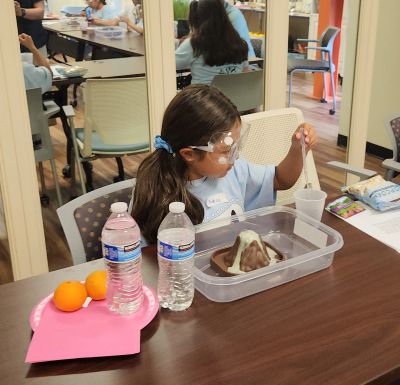
The inaugural workshop welcomed nine girls, who completed three interactive science experiments designed to spark curiosity, encourage critical thinking, and build confidence in STEM. The enthusiastic participation and positive feedback from students and their families demonstrated the impact of community collaboration and reinforced the project's mission of inspiring the next generation of women in STEM.

The Young Women in Science Project is a youth-led initiative founded by Jimena Furie, a committed 16-year-old determined to inspire the next generation of female innovators. Our mission is to empower young girls to explore their curiosity, embrace scientific thinking, and envision themselves as future leaders in STEM.
Through hands-on classes, engaging experiments, and introductory lessons on research and laboratory skills, the project creates a supportive and fun learning environment where girls can discover the excitement of science. By offering mentorship and real scientific experiences, we aim to build confidence, spark ambition, and open doors to future opportunities in science-related careers.
We believe that every girl deserves the chance to see herself as a scientist—curious, capable, and powerful. The Young Woman in Science Project exists to make that vision possible.
Why Encouraging Girls in STEM Matters
Encouraging young girls to pursue careers in STEM is essential for building a more innovative, equitable, and prosperous future. When girls are empowered to explore science, technology, engineering, and mathematics, they bring fresh perspectives and diverse problem-solving approaches that drive progress. Increasing their participation helps close gender gaps, ensures that the technologies and solutions shaping our world reflect the needs of all people, and opens doors to well-paid, fulfilling careers that can transform lives and communities. By supporting girls’ interest in STEM early, we not only invest in their potential but also strengthen the global talent pool needed to tackle the complex challenges of tomorrow.
Key Statistics on Gender Gap in STEM
- In the U.S., although women make up nearly half of the overall workforce, they held only about 27% of STEM jobs as of 2019.
- Even when women earn STEM degrees, they remain underrepresented in many STEM occupations. For example, women accounted for only about 32.4% of all STEM bachelor's — master’s — and doctoral degree recipients in the 2017–2018 academic year.
- More specifically, in undergraduate science and engineering fields: while women earned roughly 50% of all bachelor’s degrees overall, they made up a much smaller share of degrees in many STEM fields — only about 24% of engineering degrees, 21% of computer science degrees, and 24% of physics degrees.
- Among the broader science & engineering workforce: women comprise about 34% of the U.S. science and engineering workforce — far lower than their share of the overall workforce.
- The growth over time has been real but slow. For instance, between 2011 and 2021, the number of women in the STEM workforce increased by roughly 31%.
- Disparities vary by field: in 2019, among U.S. STEM occupations, women made up about 48% of life scientists and 65% of social scientists, but only 35% of physical scientists, 26% of computer and mathematical scientists, and a mere 16% of engineers.
What These Numbers Mean
- Underrepresentation persists: Even though women earn many college degrees, and increasing numbers are entering STEM overall, they’re still a minority in most technical and engineering fields.
- Field-by-field imbalance: Women are better represented in life and social sciences, but far less in engineering, computer science, math, and physical sciences. That means many STEM specialties remain heavily male-dominated.
- Lost economic & societal potential: Given that STEM jobs tend to offer higher earnings and strong demand, underrepresentation of women means fewer women benefit economically — and society misses out on their talent, ideas, and innovation.
Why This Underscores the Need to Encourage Girls Early
- Since women remain a minority in STEM — especially in high-impact areas like engineering, computer science, and physical sciences — encouraging girls early can help close that representation gap.
- More representation means more diversity of thought and approach in designing solutions, technologies, and systems that affect everyone.
- Offering girls exposure, encouragement and opportunities helps ensure that talented young women don’t self-select out because of stereotypes or lack of role models.
Sources
- Women Making Gains in Stem Occupations but Still Underrepresented. United States Census Bureau. https://www.census.gov/en.html
- How many women Graduates with STEM degrees? USA Facts. https://usafacts.org/
- The State of U.S. Science and Engineering. National Science Foundation. https://ncses.nsf.gov/pubs/nsb20221
- STEM Statistics: Workforce. National Girls Collaborative Project. https://ngcproject.org/
- STEM Statistics: Higher Education. National Girls Collaborative Project. https://ngcproject.org/